
Wort Dilution & Boil-Off Calculator
Calculate water additions to dilute over-gravity wort or boil durations to concentrate pre-boil gravity.
Wort Dilution & Boil-Off Evaporation
Enthalpy and mass balance equations for adjusting wort volume and gravity
Conservation of Gravity Points Mass Balance
V_1 \times GU_1 = V_2 \times GU_2Gravity units (GU = (SG - 1) × 1000) represent total dissolved sugar mass. Because water additions contain 0 GU, total dissolved points remain constant while volume changes.
- 1Select Dilution Mode if your mash efficiency was higher than expected and OG is too high.
- 2Enter current volume and current measured SG, then enter your desired target SG.
- 3The calculator outputs exact gallons, quarts, and liters of sterile water to add.
- 4Select Boil-Off Mode to calculate post-boil concentration based on kettle evaporation rate and boil duration.
Recommended Equipment for this Tool
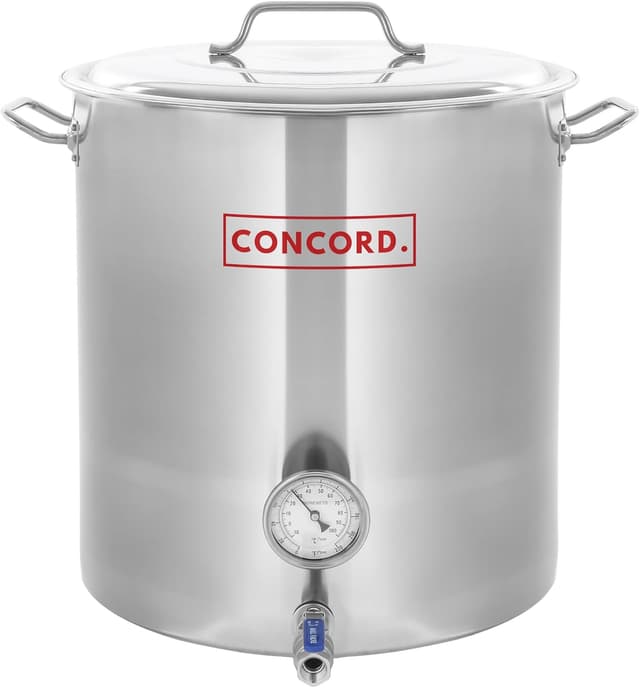
CONCORD 10-Gallon Tri-Ply Stainless Steel Home Brew Kettle
A quality brew kettle requires an encapsulated aluminum core base to prevent hot spots and scorching during long 60-90 minute boils. The Concord 10-gallon kettle features commercial-grade 1.0mm 304 stainless steel with a heavy tri-ply bottom compatible with gas burners and high-power induction cooktops. Includes pre-drilled ports with a 1/2" full-port stainless ball valve and 3" face bi-metal thermometer.
Should I dilute in the boil kettle or the fermenter?
Diluting in the boil kettle before or at flameout is safest because boiling sterilizes the water. If diluting in the fermenter, always boil and chill your dilution water first to prevent bacterial contamination and oxidation.
How do I determine my kettle's evaporation rate?
Boil a known volume of water (e.g. 6.0 gallons) for exactly 60 minutes with your normal burner flame and kettle lid off. Measure remaining volume. The difference in gallons is your system's hourly evaporation rate (typically 1.0 to 1.5 gal/hr).
Explore Other Brewing Tools
View All 8 ToolsPut This Tool Into Practice
Test your brew day calculations against authentic BJCP style profiles and all-grain grain bills: