
Hydrometer Temperature Correction
Adjust specific gravity readings taken at non-calibration wort temperatures with ASBC thermal expansion polynomials.
Hydrometer Temperature Correction
Thermal expansion adjustment based on the ASBC polynomial equation
ASBC Liquid Thermal Expansion Polynomial
SG_{\text{corrected}} = SG_{\text{measured}} \times \frac{c(T_{\text{measured}})}{c(T_{\text{calibrated}})}Where c(T) = 1.00130346 - 0.00013472212·T + 0.0000020405259·T² - 0.00000000232820948·T³. Adjusts for liquid density expansion at elevated temperatures.
- 1Take your hydrometer reading from the test jar and record the raw uncorrected SG (e.g. 1.050).
- 2Immediately measure the temperature of the wort sample using a digital thermometer (e.g. 110°F).
- 3Confirm your hydrometer calibration standard (printed on the internal scale, usually 60°F in the US or 68°F in Europe).
- 4The calculator displays true corrected specific gravity and the exact gravity point offset.
Recommended Equipment for this Tool
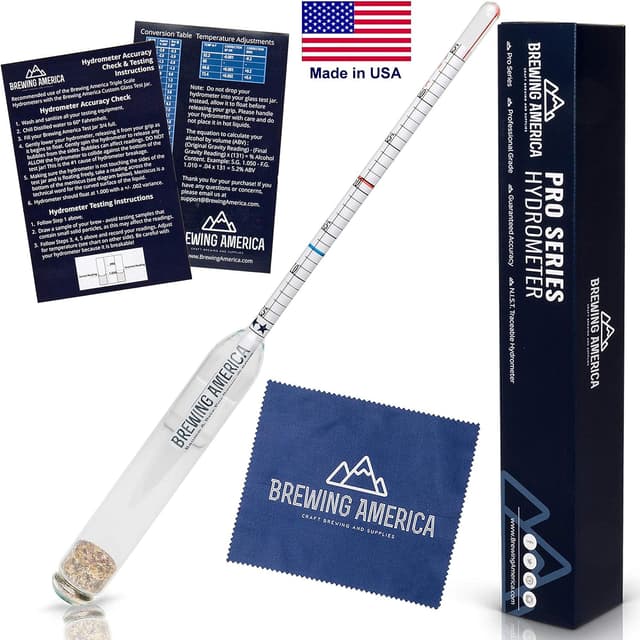
Brewing America Triple Scale Hydrometer & Glass Test Jar Set
Cheap imported hydrometers are notoriously inaccurate, often off by 4-6 specific gravity points. Brewing America's hydrometers are hand-calibrated in the USA to NIST-traceable standards. Includes a crystal-clear heavy borosilicate glass test cylinder that won't cloud or scratch like cheap plastic cylinders, plus a microfiber cleaning cloth and storage case.
Why does warm wort give a false low reading on a hydrometer?
Liquids expand when heated, decreasing their density. A less dense warm wort offers less buoyant upward force, causing the glass hydrometer to sink deeper into the cylinder and show a falsely low gravity reading.
Can I measure boiling wort directly with a hydrometer?
Never place a standard glass hydrometer in boiling wort (212°F). Thermal shock will shatter the glass bulb, and hot wort can warp acrylic test cylinders. Always chill your test sample below 120°F before taking a reading.
Explore Other Brewing Tools
View All 8 ToolsPut This Tool Into Practice
Test your brew day calculations against authentic BJCP style profiles and all-grain grain bills: